
Start the furnace on a mild day in late September, stand beside it for one full cycle, and you will learn more about your winter than any forecast will. Almost everything that fails in a forced-air furnace fails on the first run after five idle months. In September that happens on a day you can open a window. In January it happens at eleven at night.
The Weather Network's fall outlook for coastal British Columbia, published September 9, 2026, expects near-normal temperatures through the season, but with sharp pattern disruptions that can drop a brief cold spell in without much warning. On this coast the first cold night does not arrive gradually.
Run it before you need it
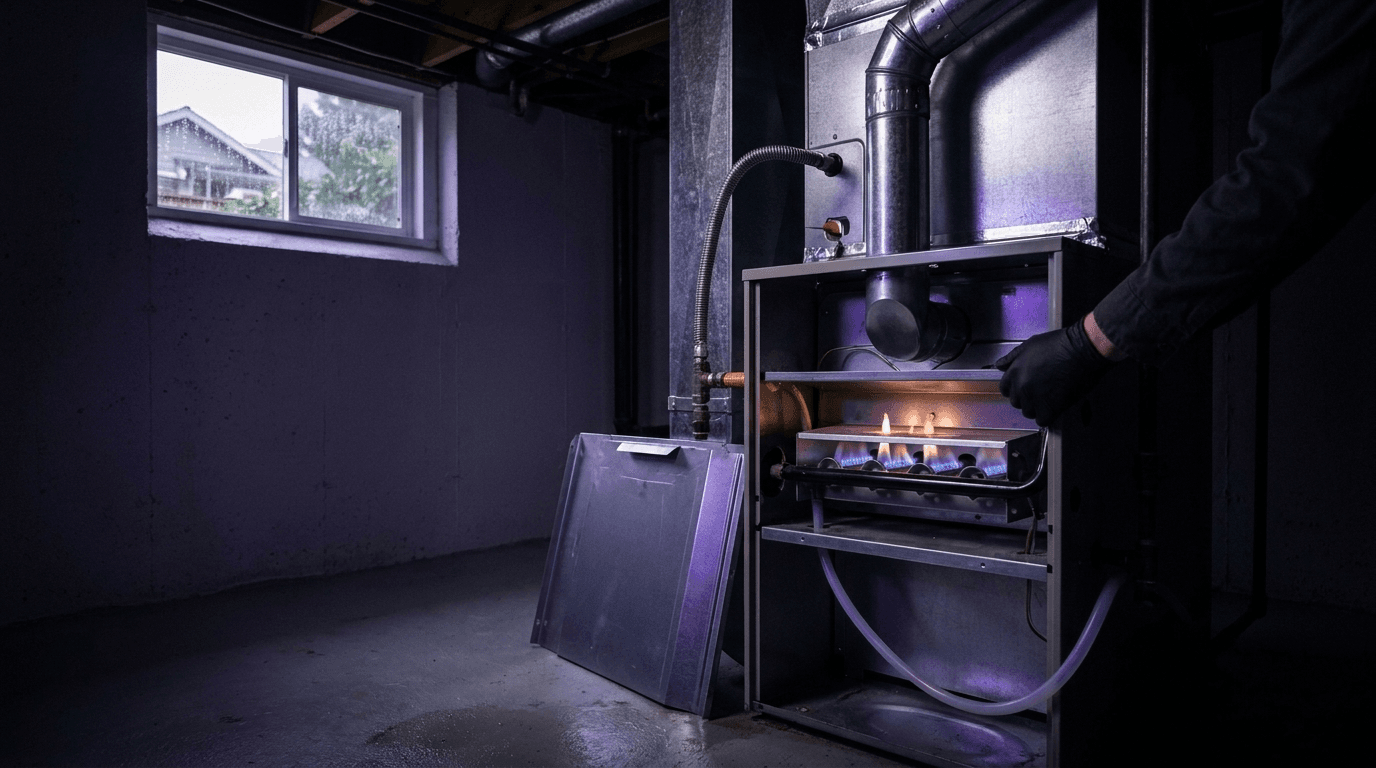
Set the thermostat about five degrees above the room temperature and let the furnace run a complete cycle: ignition, burners, blower, shut-down. Fifteen minutes is enough. The point is not to heat the house. It is to make the furnace show you what it does while you still have a choice about it.
Test the carbon monoxide alarms first
Before the burners light, press the test button on every carbon monoxide alarm in the house. The Province of British Columbia's carbon monoxide safety page, last updated September 2, 2026, asks for at least one alarm on each level of the home and near sleeping areas, kept at least 15 feet from fuel-burning appliances. Carbon monoxide does not irritate and does not hurt, and the early symptoms that page lists — headache, nausea, dizziness, sleepiness, confusion — are the symptoms of a flu you would otherwise wait out.
If an alarm sounds
The Province's instruction is not "open a window". If anyone has symptoms, leave the house immediately and move to fresh air, then call emergency services. If nobody has symptoms, still go outside first, then call the fire department or a licensed contractor.
Read the model number off the furnace tag
Find the rating tag inside the furnace cabinet or on its side and write down the model number. Technical Safety BC has a standing notice about carbon monoxide exposures traced to residential gas furnaces built between 1989 and 2011 by Carrier Corporation and sold under the Carrier, Bryant, Payne and Day & Night names. The part it names is the polypropylene-lined secondary heat exchanger. If your model number is on that list, the question is not the age of the furnace. It is the heat exchanger.
You should immediately contact a licensed contractor to test for the presence of elevated carbon monoxide levels, and have them inspect and repair affected furnaces throughout the remainder of the service life.
What the first cycle should sound like
Ignition, then a steady burner, then the blower half a minute later, then quiet at the end. What you are listening for is the exception: a bang at light-off, burners that light and drop out and light again, a blower that cycles while the burners never settle, or a rattle that arrives with the blower and leaves with it. Note which of the four it was. It is the most useful thing you can tell whoever comes to look.
Before the first cold week
- Run the furnace for a full cycle on a mild day.
- Press the test button on every carbon monoxide alarm.
- Write down the model number from the furnace tag.
- Fit a new filter, facing the arrow the right way.
- Open every supply and return vent in the house.
- Change the thermostat batteries if it takes them.
- Clear leaves and debris from the outside intake and exhaust.
When to stop and call
Shut it off and call if a carbon monoxide alarm sounds, if you smell gas, if the burners will not stay lit, or if the smell is still there on the third run. Those four are not a diagnosis. They are the point at which running it again is the expensive option. The rest of the list — an unchanged filter, a vent somebody closed in July, a thermostat with dead batteries — you can do yourself this week.