
Cooking on gas is the most common reason people add a gas appliance to a home that did not have one, and it is usually a straightforward job. It has a few parts that surprise people, so they are worth knowing before you buy the range.
If there is already a gas line at the range location
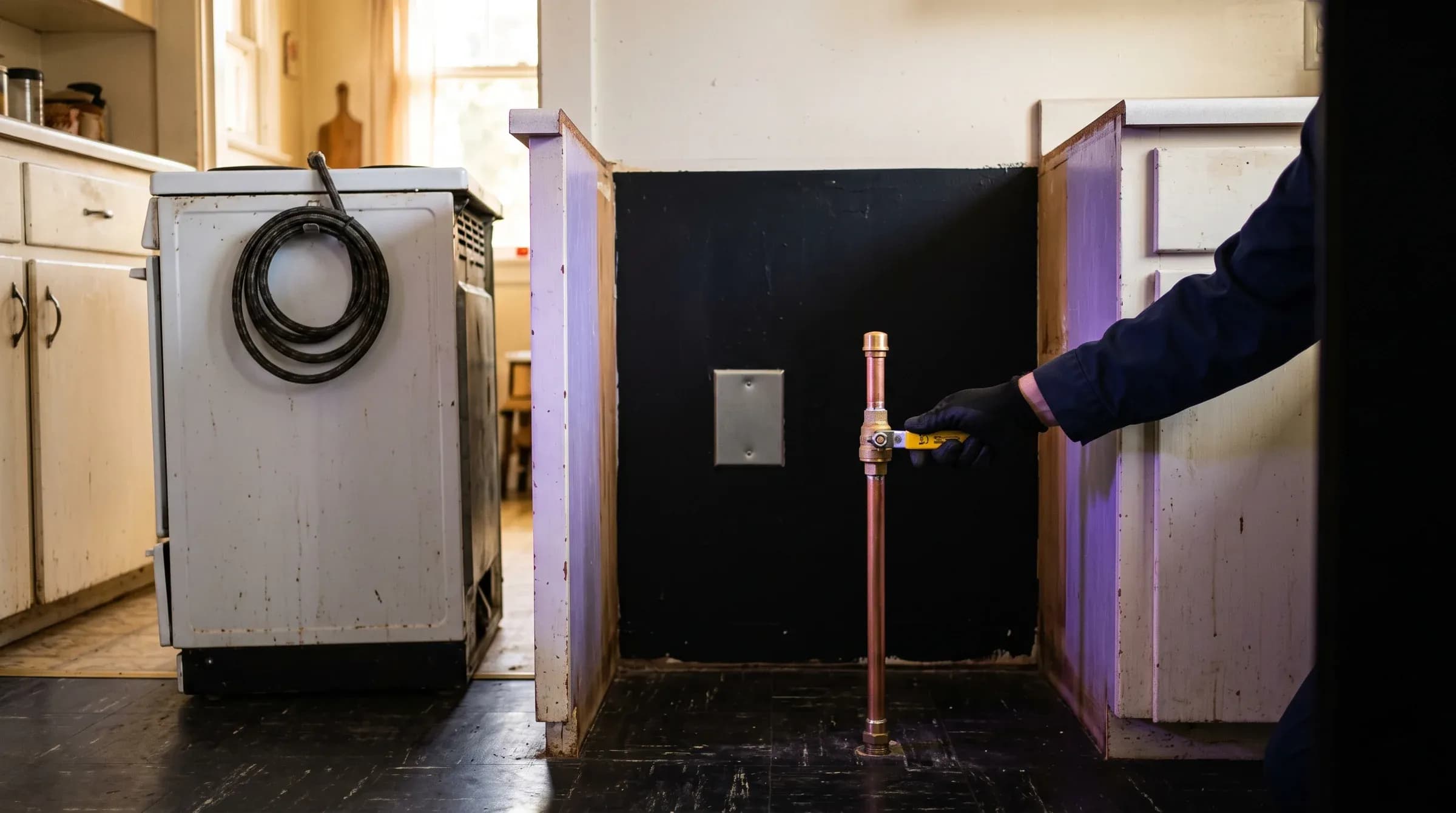
Then this is a hookup, not an installation. The appliance is connected with an approved flexible connector, a shutoff valve at the appliance, and a leak test on the connection.
Two things still get checked: that the line is sized for this appliance's load — the question adding a gas appliance is about — and that the shutoff is accessible. A range pushed tight into a cabinet run with the shutoff behind it is a problem the first time someone needs to close it in a hurry.
If there is no gas at that location
Then the work is getting a line to that cabinet, and the difficulty is entirely about the route.
A kitchen on a slab with finished floors and no basement below is the hard case. A kitchen above an unfinished basement is usually the easy one, because the run can come up through the floor at the right point.
The other constraint is that ranges sit in a specific position with cabinetry either side, so the line has to arrive in exactly the right place — there is no flexibility to bring it to a convenient spot nearby.
The electrical you are leaving behind
An electric range runs on a heavy dedicated circuit. When you switch to gas, that circuit becomes redundant — but a gas range still needs a standard outlet for its ignition, controls, clock and light.
So the sequence usually is: the old heavy circuit is dealt with properly by an electrician, and a standard outlet is provided in the right place. This is electrical work and it belongs with an electrician, not a gas fitter. Coordinating the two is part of planning the job.
People frequently do not budget for this half, and it is the most common surprise in a range conversion.
Ventilation
This is the part that gets skipped and matters more than most people realise.
Gas cooking produces combustion products in your kitchen. A range hood that vents outside removes them. A recirculating hood — one that filters and blows the air back into the room — does not; it handles grease and some odour, and it does nothing about combustion products.
If you are moving to gas cooking and your hood recirculates, that is worth addressing at the same time. Ducting a hood to the exterior during a kitchen renovation is far easier than adding it later.
Use the hood when cooking, on a setting that actually moves air. It is not just for smoke.
Other appliance conversions
Dryers are usually simpler — a short run in a laundry area, and gas dryers vent as electric ones do. The main consideration is that the venting is correct and unobstructed, which on an existing dryer vent is worth checking anyway.
Outdoor appliances are covered in Outdoor gas: barbecue and fire table lines.
Fireplaces are a bigger job because of venting, and Gas fireplaces need annual service, and here is what that service does covers what they need once they are in.
Gas appliance connections are permitted and inspected work in this region, and gas fitting is licensed in British Columbia. The inspection includes a leak test on the connection and confirmation that the line serving it is adequate for the load.
Buying the appliance
Check what the appliance needs before it arrives: the gas type it is configured for, whether a conversion kit is required, its clearance requirements, and its ventilation requirements. Delivery day is a bad time to discover a mismatch.
Also confirm who is connecting it. Some retailers include connection and some do not, and "installation" in a delivery quote sometimes means placing it in the opening and nothing else.
Timing it with a renovation
If the kitchen is coming apart anyway, this is dramatically cheaper. Line routing, the electrical work and the hood ducting are all easy with cabinets out and walls open, and all awkward afterwards.
Vancouver, Burnaby, Richmond, Coquitlam, Port Coquitlam, New Westminster. 604-865-7979.
Related: Gas appliance hookups · Gas line installation · Kitchen plumbing and renovations